Reading the connections
The examples and shape descriptions below use Playwrite US Trad, shown as Traditional in the maker. The solid line under the small letters is the baseline; the dotted midline marks their usual height. Look at the connecting line and the space around it, as well as each letter.
Modern uses Playwrite US Modern and changes some shapes and connections, as noted in each group. The reference charts below stay Traditional when you change the maker. Use the same text in its preview to compare the two fonts. These are the supplied font models; letterforms may differ from those used at your school.
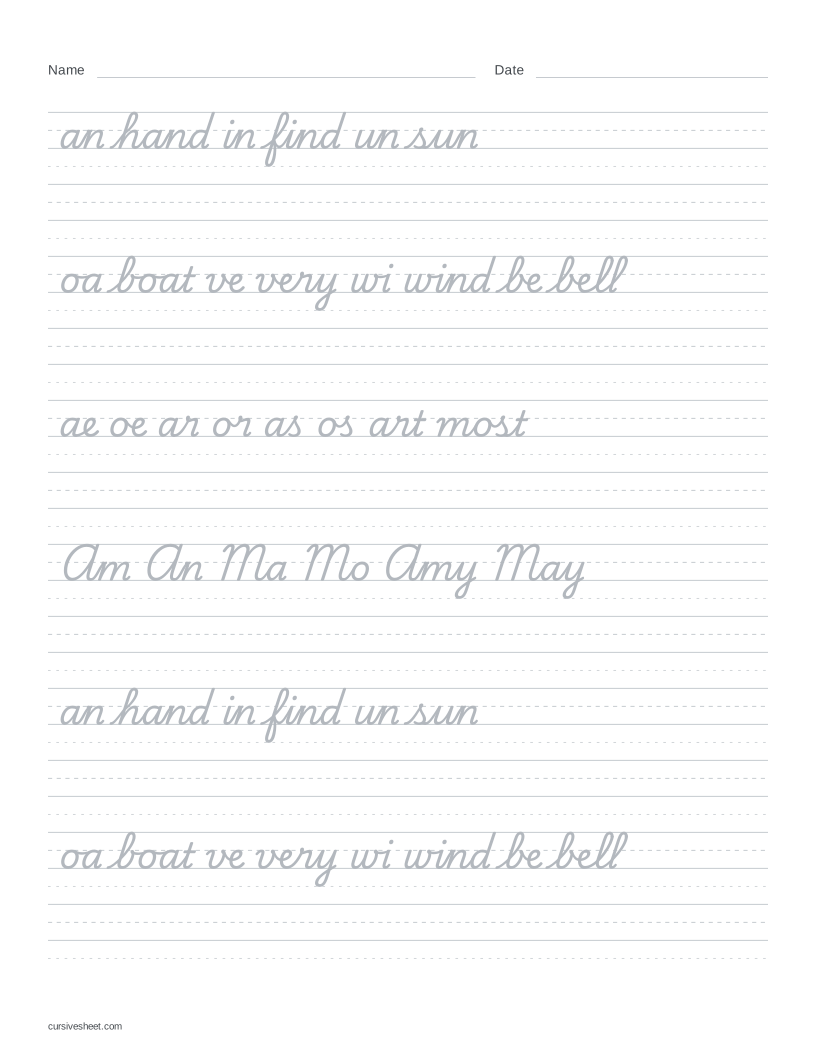
Low joins: an, in and un
In Traditional, the connection in an, in and un curves up from near the baseline into n. The low curve sits between the two letters, below the dotted midline. Find the same pairs in hand, find and sun.
Modern keeps a low connecting curve in these pairs, with more upright letters. Load Low joins to compare the pairs with their words.
High joins after o, v, w and b
In Traditional, oa, ve, wi and be have a connection near the dotted midline. Look at the bridge after o in boat, v in very, w in wind and b in bell. The connection after b is beside the small-letter midline, below the top of its tall loop.
Modern also shows raised connections in oa, ve and wi. Its b has an upright stem without the tall loop, and there is a visible gap between b and e in be and bell. Compare be and bell in the preview when switching styles.
Connecting cursive letters to e, r and s
Compare ae with oe, ar with or, and as with os in Traditional. The connection into the second letter is lower after a and higher after o. The small loop of e is visible in ae and oe; r has a short shoulder near the dotted midline; s has a narrow, sloping shape. Find these pairs in aerial, poem, art, orbit, ask and most.
Modern has a more upright r and a wider, more open s than Traditional. Load Into e, r, s to see each pair beside words containing it. Do not assume the same connection suits every letter.
A capital followed by lowercase letters
Traditional connects A to m or n in Am and An, and M to a or o in Ma and Mo. Look at those connections in Amy, Anna, May and Monday. The capital reaches the top guide while the next small letter sits around the dotted midline.
Modern leaves a visible gap after A and M in these examples. A word can contain a break in this model; do not add a connecting line that the preview does not show. These examples do not describe every capital.
Practice a pair, then a word
Choose a group button to load its pairs and example words into the maker. The starting sheet uses Small letters, Faded tracing and Trace + blank rows. Trace a pair, trace a word containing it, then copy both onto a blank row. Compare the height of the connection and the space between the letters with the model.
For a shorter cursive connections worksheet, keep just one pair and one word, such as oa and boat. Choose Solid if you want a dark model to copy instead of tracing. You can adjust the practice to suit your time; no result or timetable is promised.
Print your chosen joins
Select A4 or US Letter to match your paper, check the preview, then download the PDF and print at actual size or 100%. The ready-made sample below is US Letter. For an A4 sheet or a different group, use the maker above.